Saturday, December 7, 2013

An American Idyll, Key Lime Pie on a Stick


Having bad mouthed the GPS navigation system continually, I must confess to some negligent navigation.  We intended to penetrate deeply into the Everglades, but I was engrossed in writing a book review and I let Hurricane Sandy cross half the state on I75 before I realized my faux pas—she was not reticent in her criticism.  It was getting toward evening as we had a late start due to pausing for breakfast with my niece, Renee, at the venue of her impending nuptials, impending as in a year in the future.  We wanted to see the hundred mile transoceanic highway to Key West in the light of day, so we stopped at the Key Largo Visitors’ Center for advice.  That may have been the smartest thing we have done on this trip.  The major hotels fax the Visitor Center promotional rates when they think they may have vacancies during the low season.  We got a room at the Key Largo Hilton with a balcony above the beach for a good price and for the following night we booked a beach front room at the Southernmost House, a beautiful boutique B&B in Key West—you guessed it, located at the southernmost point in the continental United States.

The Hilton was actually just OK.  It was past its prime and looked very much like a Mexican hotel, but we could hear the waves and enjoy the sea air until some miscreant had to smoke on his balcony forcing us to close the doors.  Our new pal, Kenny, at the Visitor Center raved about a restaurant on Islamorada called Marker 88 which was easy to find even in the dark because, you guessed it—it was at mile marker eighty-eight.  We got to dine in a canopy covered glider, which was delightful and fun to swing as we dined, but the breeze was brisk and by the time we finished excellent meals of hogfish and seafood salad, we were a bit chilled.

I forgot to mention that the good price offered by the Hilton was tempered a little by the eighteen-dollar “resort fee” they tacked onto the rate.  This was ostensibly to cover outdoor parking, internet access and something else that I don’t remember, but it wasn’t toilet paper which was in really short supply.  They also gave us a very odd bar of soap.  Its shape was reminiscent of a Paleolithic stone tool and it had a circle of little domes at one end.  The thing was so kinky looking I turned it over to see where you put the batteries.

Being less than enamored of the Key Largo Hilton, we left in the morning without lingering.  The highway south is, of course, the only way in and the only way out of the Keys, often with just one lane each direction crossing many, and frequently long, bridges.  I don’t believe we were beyond Islamorada when we saw an electronic sign telling us about a “major crash” at marker 63 and to expect delays.  Well, there were already plenty of delays in all the little Podunk towns that hadn’t existed in 1969 when I last made this drive, however, the congestion paled by comparison to the brick wall we hit about marker seventy-five.  It was the sort of traffic jam where you stopped the engine and got out to walk around a little.  I read the National Geographic while the Hurricane played with her phone.  It took an hour and a half to reach the crash site which was on the downhill slope of a bridge.  The participants had been hauled from the scene but we could tell where it happened by the prodigious oil slick on the pavement.  Immediately on exiting the bridge, we saw a truck, actually the tractor of a big rig, spread across a flatbed trailer.  I have never seen a truck cab quite as mangled and I reflected for a moment on having one less truck driver to despise.  As soon as we had seen the “major crash” notification I knew with certainty that the culprit would be a truck driver.  I didn’t guess, however, that it would involve two trucks, or that they would have crashed head-on.  Eventually we overtook the other truck being towed south.  Being much less mauled than the first, that driver might have survived.

The congestion caused by the aftermath of the accident never dissipated and it was a stop-and-go drive all the way to marker zero at the Southernmost House.  At the end of South Street, where it crosses Duval, both terminating on the sand, there are numerous institutions claiming to be the southern most something.  We got confused by the Southernmost Hotel and parked in their lot, but we recognized the gingerbread architecture of the place we were supposed to be on the opposite corner and eventually found our way to the lobby.

Ocean Ten Feet in Opposite Direction

Our room was a building unattached to the historic house but we were not going to complain since it was isolated from the rest and sat on a narrow concrete pad knee high above the water.  Our windows opened onto the sea and the following morning we watched the sunrise from bed.

Sandy was anxious to see the town.  She was excited about seeing Key West for the first time and I felt lucky being to show it to her.  This was my fourth visit.  As I previously mentioned, I had driven to it in 1969 with two male friends of dubious character.  We were underfunded and ill quipped.  My old Chevy Nova was so badly in need of front-end work it wore through a tire every hundred miles.  We made the trip from Ohio on five dollar used tires that we bought along the way.  In those days Key West was a pristine little paradise not much bothered by tourists.  Duval Street was paved but most of the side streets were white sand.  I couldn’t have loved it more.  I visited twice more in the eighties, arriving by air, and of course was heartbroken by the development, but despite the rape of Eden and the huge, inexplicable influx of gay guys, it still abounded with charm.

In the eighties I had been given an insider’s look at the attractions by a dear friend who lived in the historic district, so I knew where to take my favorite hurricane.  We walked Duval from end to end, bought a souvenir tee shirt at Sloppy Joe’s for our long suffering dog sitter, had a drink at Captain Tony’s—the original site of Sloppy Joe’s in the Hemingway era—and we crossed Mallory Square before the loonies arrived for their sunset performances.  I was glad to find the Mel Fisher museum still operating even though most of the treasure salvaged from Nuestra Señora de Atocha has been removed.  When the salvage was in full swing, there was so much gold and silver that they had difficulty housing it.  The loaf of bread sized silver ingots were stacked against the walls completely around the interior of the warehouse.  They were too heavy to grab and bolt so there was no security wasted on them.  The rather smaller gold ingots were pocket sized, so they were behind glass as was the mind-numbing array of jewelry.  I remember a gold crucifix about nine inches long, three quarters inch wide and half inch thick, also a gold chain of three inch long links a half inch in diameter.  The thing had to have been ten feet long.  Today the remaining treasure on exhibit is modest by comparison, but Sandy had no frame of reference so she was delightfully impressed, especially by the emeralds.

On the long weary trek back to the hotel we stopped at Margaritaville for some peel and eat shrimp and a libation.  Sandra had a ‘Perfect Margarita,’ that’s what they called it and she endorsed the claim.  I had a less than perfect Tanqueray and tonic.  For my second I had to specify a much shorter glass.  (Why would a person pay extra for the taste of Tanqueray if it were going to be drowned in sixteen ounces of tonic water?)  We hadn’t been in a Margaritaville since the Kingston airport in 2007 where you could not get to the departure gate without passing through the bar, which seemed strange to me, but I didn’t object.  Invigorated by the excellent shrimp, we resumed our hike to the beach although we stopped in a wine shop where we bought a mature bottle of Hess cabernet that we drained on the concrete apron outside our room while watching the tide rise.

I wanted to take Sandy to dinner at the Half Shell Raw Bar which is rather iconic but we didn’t see it during our outing and I had no clue where it was.  My memory of 1986 is extremely selective, but fret not.  The squirrelly night clerk helped us and it was, naturally, at the opposite end of Duval Street which was much more than our aged bodies could manage, so the obliging clerk called a cab that turned out to be driven by a New Zeeland transplant.  The place had not changed in twenty-seven years except possibly that the clientele was considerably more advanced in years.  I got us a dozen oysters to wash down with our Tanquerays while we decided on second courses.
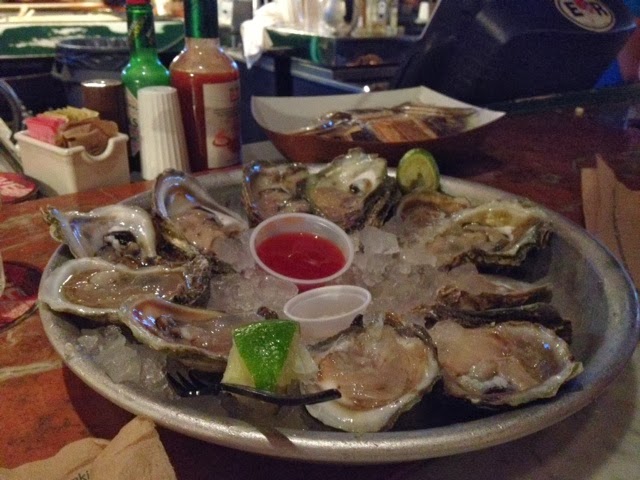

Succulent looking, aren’t they?

Sandy’s calamari rings were a lot better than my conch fritters which were basically hushpuppies alleged to contain trace amounts of conch.  The conch chowder I had at Marker 88 was equally devoid of mollusk meat.  Judging from the number of shells in the gift stores, I suppose they are an endangered species now.

As the exceedingly informal dinner in the license plate decorated bar ground to a close, I was feeling somewhat nostalgic, or maybe it was just plain pissed about the oozing blight on my lower leg that was preoccupying everything I did and thoroughly preventing me from enjoying my vacation, not to mention staining my last pair of clean pants.  Later I got a reply to the latest email I directed at the little Hindu MD back in Pomona.  He said, “How’s it going with the sore?”  I could have choked him.  I didn’t need compassionate concern, I needed antibiotics.

Our Southern Most House sojourn ended soon after the previously mentioned sunrise that I admired with coffee from bed while the Hurricane ran outside in her nightgown to photograph it framed by the foliage.  She got a couple good shots which I will share if she ever downloads them from her camera.

I wanted Sandy to see the Hemingway house so we went straight there after checking out of the hotel.  Of course I’d seen it in ’86 but it reignited some fond memories and I gained capital with the guide when he faltered over where Hemingway bought the shotgun with which he shot himself.  It was Abercrombie and Fitch, of course.  That’s where he bought all his gear.

Walking to the car, Hurricane Sandy saw a place that offered key lime pie on a stick and had to try it.  It sounded like a ridiculous idea to me but I ate one and it was pretty good.  For the uninitiated, there is nothing special about a key lime other than the fact that they are small and have a lot of seeds.  It is the same fruit that in California we call a Mexican lime, but if you’re not squeezing them into your gin and tonic or onto your taco, there is hardly a better use for them than a pie.  I’ve never had a key lime pie, even the one that Sandy made when I received a bag of key limes from my Key West connection, that didn’t look, and taste, as if it could have come from Sara Lee.  For some reason I can’t help but suspect that somewhere in a musty trunk in a plantation house attic lies an antebellum recipe for key lime pie that is as it was meant to be in a bygone time.

In the next installment: Fear and Loathing in Jupiter, Florida.

Tuesday, December 3, 2013

An American Idyll, Part II


November 25

Lounging at Baton Rouge, we had browsed for a bed and breakfast inn at Pensacola and found one that looked like our style, so I made a note of the phone number before we hit the road for New Orleans.  Once back on I10 I called the B&B but got a machine on which I left our message.  We did not get a return call and I remarked about five o’clock that they must be full and couldn’t be bothered to tell us.  It wasn’t ten minutes later that my phone rang, since I was driving, I handed it to the Hurricane who conducted what I thought was a slightly strange conversation for making reservations.  It seems there was a vacancy but Russell’s Roost B&B only took cash or personal checks which was OK with us.  We had trouble finding the place because Google Maps navigation for iPhones has attention deficit disorder.  However, we rang the bell and an elderly lady (Elderly?  Listen to me.) answered with her mouth full.  We apologized for interrupting dinner but she would have none of that and welcomed us into the foyer, telling us that she was the only one there.  We thought it nice to have the run of the place but both of us were thinking of the Bates Motel.  In the end we were not knifed in the shower.  It seemed she had sold the place and was waiting for escrow to close, and when she got our call, she thought it would be nice to have some company.  We were not much company that evening as we went to dinner and straight to bed, but in the morning she joined us for breakfast where we had a lovely chat learning her life story and plans for the future.  We thanked her for her hospitality and I gave her my last copy of In the Blood.

I have been keeping a secret from you.  On Sunday a sort of a carbuncle developed on my leg.  I know that because I Googled it.  By Monday morning it was ten times as large, swollen, feverish and emitting things you’d rather I didn’t describe.  I was not pleased.  We found an urgent care facility—but it looked more like an ER—in the Baptist/Mayo Clinic Hospital of Pensacola and I began to think in terms of four figure co-pays.  The place was very efficient and they had me in the middle of a rabbit warren of halls and examination rooms before I could say “Obamacare.”  Of course I had to sit and or lie there for about forty minutes before Jeremy, the physician’s assistant who couldn’t have been old enough to have been to med school, arrived to proclaim it a staph infection, wrote a prescription and vanished back into the labyrinth.  Within minutes I was shown the cashier who thought it a long shot, but was willing to try billing Aetna.  I must say that their system of treating the patient before going through the completing forms process makes a great deal of sense, since even if I had been indigent, they would have treated me anyway and stuck the tax payers for the bill, so there was no point in worrying about all that up front.  As I write this a week later, the pills are gone, the sore is worse and my Indian doctor pal back in Pomona returned my email to say that I should try not to think about it.  This is not a happy-making thing.  I’m sure it’s antibiotic resistant, flesh eating bacteria that I acquired by spending way too much time in medical facilities of late.

Tuesday was a long, torturous drive through blinding rain from Jacksonville to our destination in the woods of Williamsburg County, South Carolina.  We were soggy but we arrived at Suttons just as the impenetrable deluge turned to Stygian darkness beneath the Spanish moss festooned oaks.  Our hosts, cousin Bill and Miss Mary, greeted us warmly and fed us excessively.  Thanksgiving was delightful as always with close to seventy people arriving to feast on Bill’s barbecued hog and the myriad of side dishes from chicken and dumplings to smoked chicken rice purlieu.  Chicken ranking second in popularity only to the hog.  We love to visit Suttons and because we come all the way from California, and because we’re old, we don’t have to sleep in the bunkhouse with the little lizards that inhabit the place.  We get to sleep in the guest bedroom of the country house.  The room is very nice but for the cold air return of the furnace.  When the heater ignites, the blower sucks a maelstrom of cold air right across the bed with such force that it pulls open the bi-fold door.  Still it beats the lizards and the all the snoring cousins.

December 1, 2013

From Thanksgiving onward to this writing on Sunday, the weather has improved steadily.  Of course, we’re heading south which might have something to do with it.

I must backtrack to Saturday.  We left Suttons by eleven-thirty headed for Georgetown to take care of a few items.  I convinced Bill to take a DNA test for genealogical purposes, and wanted to put his specimens in the mail, but the post office closed at eleven on Saturdays.  We wanted to see if the library had a census of the Sampit Methodist cemetery because somebody has erected a memorial to my great-great-grandfather, George Washington Skipper, who isn’t buried there.  I am curious as to who did it and why, however, the library was also closed.  I pitched In the Blood to a couple of bookstores, including one that is currently occupying an historical building that is mentioned in the book, Sandy did a little Christmas shopping and we surveyed the devastation left by a recent fire that destroyed seven historic buildings on the riverfront.

Before we made it into Georgia I got a ticket in a hick-town speed trap.  The speed limit sign was behind a bush and the zealous cop came after us with lights and sirens as if he were on a call to get a cat out of a tree.  All the other cars on the street were whizzing past us but that California license plate was just too much for Officer Nelson, a portly black cop—so I didn’t even get the satisfaction of calling him a redneck—to resist on the last day of the month with his ticket quota obviously not yet filled.  Again I blame the malignant GPS, because without her unwaveringly bad council, we would have been on the interstate.

Our goal was Savannah, but we needed to enter Savannah by the backdoor because during the aforementioned deluge we had stopped at Pep Boys to buy some new windshield wiper blades that didn’t work.  Again the GPS led us on a wild goose chase, telling bald-faced lies and obfuscations, but by a miracle, we found Pep Boys again and pleaded our case.  David, a middle-aged black gentleman, offered to solve the problem with a smile.  He gave it the college try, but after nearly an hour, he said, “We’ll refund your money.  Take the damn thing to Jaguar.”  So now we have an expensive pair of new wiper blades that we got for free but they don’t work.  I shudder to think what Jaguar charges for wiper blades.

It was dark by the time we left Pep Boys and the malevolent GPS bitch was in her glory.  She ran us around the west side of Savannah in large circles for over an hour.  I finally got pissed and bought a map which didn’t help much since the street we were on wasn’t listed in the index.  Eventually, after many testy remarks flowing both ways, we found the hotel and realized it wasn’t the one we expected.  However, it was within walking distance of the riverfront, and despite a three-hundred and fifty guest wedding running amuck in the lobby, we stayed.

More to follow.

PS: Face of the Angel is being featured by Indie Tribe as a Christmas Special.  Since they were kind enough to feature me, I should reciprocate by providing their link, and here it is:  http://www.theindietribe.com/special-christmas-showcase-ho-ho-ho/  You may be surprised to know that Dr. Mengele was fond of Christmas and even played the role of Saint Nicholas once for a Bavarian family’s children.

Tuesday, November 26, 2013

An American Idyll


November 21, 2013

This is the second day on the road.  I should have told you we were leaving but things got hectic during the preparation to depart.  We spent the night in Gallup which is hardly thrilling, but unless one is really dawdling, from Southern California Winslow is too close and Albuquerque is too far.  This is our sixth jaunt across country so we’ve seen the Meteor Crater, all Winslow has to offer and we sampled the hospitality of Holbrook, thus a marginal Quality Inn in Gallup was as good as it was going to get.

Dinner was another matter.  I hate Applebee’s—a chain with so many things on their menu that the chef, nay cook, doesn’t know how to make any of them.  The worst meal I ever had was at an Applebee’s in Marietta, Ohio.  However, it was raining, Applebee’s was next door and the key card from Quality Inn got us a ten percent discount.  I knew I’d regret it.  First we got carded.  We qualify for the senior discount and we got carded.  When the waitress saw our out of state drivers’ licenses she said she had to show them to the manager.  I ask her why but she had no clue.  Then the gin and tonic arrived in a sixteen ounce glass with enough tonic water to give me quinine poisoning.  Clearly the girl was not a drinker—which is good because Indians should stay away from firewater—and incredibly it was also clear the bartender was not a drinker.  I also tarred the manager with the teetotaler brush because no kindred spirit would card a geriatric and run off to the corner to fondle his ID.  The place was simply weird and the food edible at best.  When we slogged back to the Quality Inn the police were busting somebody in Applebee’s parking lot.

Many people play counting games while driving to pass the time—a certain kind of car, or the cows on your side of the road as compared to the opposite side.  I like to count truck drivers whom I’d like to see dead.  They got worse as the day proceeded and the weather deteriorated.  I think they keep taking speed throughout the day until they are completely nuts.  We also counted six thoroughly flattened coyotes.

We just passed the metropolis of Cuervo, New Mexico, where one finds about a hundred derelict adobe houses, a quaint old abode church—also in ruins—perhaps a thousand junked cars, a gas station and three shabby old trailers.  We opted not to stop.

The following morning, at Amarillo, while basking in the warm glow of the Holiday Inn, filled with the gratifying excesses of the Texas Roadhouse which shares a parking lot with the hotel thus enabling us to imbibe with impunity, we decided to check the weather channel.  Plans changed quickly.  Sleet and snow were bearing down upon Oklahoma City and points east.  We grabbed a quick complimentary breakfast and dived south.  It was breezy driving until Lubbock when Hurricane Sandy Skipper, my adored spouse, took the wheel and the rain arrived.  Soon the road was ice and slush and traffic flow dropped from eighty to thirty miles per hour.  It was a long, frigid drive to the suburbs of Fort Worth where we passed an uneventful evening.

November 23, 2013

As I write this, the plunge south continues through intermittent rainsqualls toward the balmy climes of the Gulf Coast with Baton Rouge and gumbo as our goal.

The day progressed with the weather being sporadically awful, but in the continually warming atmosphere, the threat of ice vanished and we made good time on excellent Texan highways.  I praised the highway system by which standard California’s are a disgrace—that is until we reached Houston.  To catch I10 the map and the GPS indicated that we had to take the outer belt else die in traffic.  Neither, however, indicated that the outer belt was a toll road and one can’t use it with the EZ-Pass.  Nowhere did it tell us what the alternative was.  After many anxious minutes and reckless lane changes we deduced that the frontage road followed the toll road but never did the county of Houston condescend to tell us that.  To be blunt, their signage sucks.

I saw the first palm trees since leaving California.  They were a comfort.

We just went into a Shell station to reload.  The pump told me I had to call Shell.  We always use Shell, and as long as we leave a contiguous trail across the continent, they don’t cut us off.  Once we drove about five-hundred miles before using the card, it was refused so fast the pump gasped.  Well, I took it philosophically—yeah, right—and called the number on the back of the card, listened to a couple minutes of spiel, entered the account number, four digits of my social, punched numerous buttons in response to vague questions, zero many times to no result, and in the end was told to press zero for a person.  There was no person, only another ethereal bitch telling me that Shell was closed.

November 24, 2013

The iPhone GPS had orders to take us to downtown Baton Rouge where I had visions of gumbo and interesting architecture.  Instead it took on a tour of barrios so dark and foreboding that we ran back to the freeway and hid in yet another Holiday Inn—overpriced for the weekend— and so far from civilization that we opted to order a pizza rather than venture into the frigid night.

On Sunday morning we vowed to make it a short day with Pensacola as a goal, but again Ms. GPS derailed us and we found ourselves on I12 instead of I10 by which we would miss Lake Pontchartrain.  The Hurricane did some manual adjustments and directed across the fabled lake on the twenty-four mile causeway which afforded us a transporting view of the New Orleans skyline with the Super Dome to the right, the Mississippi bridge on the left with the sun sparkling on the waves before it.  The lure was too great and the next thing we new knew, we were headed for lunch in the Vieux Carré.

The French Quarter is an amazing place for many reasons, but I think the most remarkable is that it still exists.  The Spanish handed it to the French who sold it to us, of course.  Thankfully, England, who was at war with both of them nearly continually refrained from burning it and they showed restraint again in 1814 before Andrew Jackson thrashed them when the war of 1812 had already ended.  More remarkably, the Yankees did not put it to the torch in 1864 and its greatest test of endurance is surely surviving twentieth century urban renewal.  I probably should give a little credit to Hurricane Katrina (no relation to my Hurricane Sandy) for sparing it and flooding the Ninth Ward instead.

It was chilly with a blustery wind from the river as we walked through the ancient blocks admiring the longevity, tourist glitz and general quirkiness of the place.  I especially admire Chartres with its plant festooned iron galleries hanging over the flagstone walks.  Jackson Square was in a good light and Hurricane Sandy attempted some pictures of the statue of Jackson doing his horseback photo-op silhouetted against the Cabildo.  We did some Christmas shopping before I steered us into Tujague’s , est. 1856, for the gumbo I didn’t get in Baton Rouge.  It was good but the soft-shelled crab doing the backstroke in it was the toughest I’ve ever chewed.  Sometimes ones quest for gumbo takes a circuitous route.

Back on the street we had an hour to kill before the prepaid parking expired so we wandered the ragged streets browsing with Sandy snapping shots of the architecture, four-hundred year old alleys and twenty-first century freaks.  One cannot help but love the French Quarter but it has its issues, not the least of which is more rude, inconsiderate and oblivious smokers per square foot than any place in the United States, save Las Vegas.  After three hours I got into the car wheezing like a teakettle.

Madness Far Beyond Hitler


The Soviet Gulag was intended for profit.  That incredible statement strips any brackets surrounding the depth of incredulity that this book describes.  Begun in the twenties, the Gulag was a two-headed scheme to rid the Soviet Union of undesirables and utilize them for the enrichment of the state and decidedly not the populace.  Stalin would decree, ‘We need a bridge.  Tell the NKVD to arrest some engineers.’  Then he might think there was an arctic oil field in need of exploitation so he ordered the arrest of geologists.  When he saw vast, empty steppes yielding nothing to the state, he ordered the forced relocation of entire cultures forcing the deportees to productively use the wasteland or die in failing to do so.  Perhaps most unbelievably, he proclaimed: ‘We need to go into outer space, arrest some scientists.’  Despite Stalin’s mania for forced labor, he actually set quotas for how many prisoners were to be shot each month and criticized camp commandants for failing to meet them.  Anne Applebaum has, in the rarified light of Russian willingness to open at least some archives, spent decades unearthing the magnitude of the Soviet Gulag system’s misuse of capital, resources and humanity.  The fact that slave labor never, ever showed a profit did not convince the Soviets, from Stalin through Gorbachev, to quit the concept, despite their own proof that it was a failed theory.


Gulag is a chilling history lesson that clarifies the nature of America’s wartime ally.  It also defines the wrongness, incompetence and total futility of the Soviet system, and by extension, communism and socialism.  The reader will be stunned by the immensity of the Gulag, its incomprehensible cruelty, ineptitude and the capriciousness with which it was run.  Finally, Anne Applebaum’s insight into how the Gulag was ultimately responsible for the collapse of the Soviet Union is an eye-opening hypothesis.  This massive work is highly readable and entertaining as well as informative.

Price $11.99 (I got burned at B&N for more than that)
Word count?  Oh, there are a great many words here.


Buy at Amazon

Monday, October 21, 2013

Angels in the Darkness


I use Grammarly's plagarism checker because I only want to steal from the best


Angels in the Darkness is a stunning achievement resulting from felicitous access to remarkable primary source material.  This is the memoir of a woman who was ten years old in 1939 and living in Berlin.  The Bolle family was wealthy, well-known and respected, living in the prestigious suburb of Dahlem from whence Jewish families began to flee after the Kristallnacht, and into those derelict houses first came high-ranking Nazis, and later American officers.  Jutta Bolle went to school with Himmler’s daughter and Field Marshall Keitel lived around the corner!


The insight Jutta shares about the family’s fear of the Nazis, the terror of the bombing and the arrival of the Russians is both warm and chilling.  Her voice is real and carries the reader right into the events that she witnessed with her description of daily life in wartime Germany.  She is both engaging and appealing, and her narrative strips bare many popularly held ideas of this formative period of human disaster.  Lisa Farringer Parker’s masterpiece will engross history buffs, war story aficionados, and human-interest fans equally.  It’s an unforgettable read!

254720 words (rather long but never slow)
$9.99 (a little pricy but you won't regret it)

Buy at Smashwords 

Buy at Amazon

Thursday, October 3, 2013

Period Piece Racism


Yes I Can is, first, the story of a remarkable entertainer as told to his close friends, Jane and Burt Boyar, in the 1960’s.  It is also a frank, painful and intimate exposé of racism as it existed during the lifetime of Sammy Davis, Jr. as well as an insider’s look at the day-to-day lives of the brightest luminaries in show business.


The twenty-first century reader who is sufficiently padded with years will recall with dismay the days of institutionalized segregation.  Although it has diminished, racism has by no means vanished and it may well be resurging in our society that is increasingly diverse and polarized.  Sammy Davis speaks personally and honestly of the racial attacks coming at him from both white and black societies, beginning with his childhood in Harlem through the Civil Rights era when he was one of the most loved and highest paid entertainers in the world.


Burt Boyar’s uncanny excellence as a writer leaves one marveling at how any author is able to capture such depth of emotion using another man’s voice.  Yes I Can is told as much in Sammy Davis’ hip lingo of the Jazz Era as in his extremely articulate English that belies his total lack of formal education.  This is a fast-paced story that takes no prisoners and challenges the reader to keep up as the pages fly and insights unfold into the life of a performer without equal.

239790 Words
Price $4.99

Buy at Smashwords 

Buy at Amazon

Friday, September 20, 2013

Mooney


Mooney is the warm and homey biography of an amazing individual who earned the title “World Master Carver.”  Undoubtedly a genius and savant, Ernest “Mooney” Warther had the strange gift of being able to visualize, in sequence and in advance, the thousands of cuts required carve his famous tree of 511 pairs of wooden pliers of diminishing size.  That someone even conceived of a pliers tree is mindboggling enough.  Mooney spent close to sixty years carving mainly models of steam locomotives in the small Ohio town of Dover where he played the role of local hero to generations.

I was especially anxious to read the story of Mooney Warther as it was my luck to have met him at his original museum when I was a boy, and naturally, he carved for me his famous wooden pliers which I regretfully lost somewhere on my long strange trip.  A few years ago, while driving through Ohio, I made a point of visiting his current museum and found the experience even more transporting as an adult.  This review, however, is not about me; it is about Mooney by John P. Hayes, PHD, which I found charming and informative.  Mooney is the story of an incredible life.  Read it and you may want to go to Dover.

Price $2.99
Buy at Amazon